

Anti-Aging Treatments Ranked: Which Med Spa Procedures Actually Work in 2026?
Anti-Aging Treatments Ranked: Which Med Spa Procedures Actually Work in 2026?
Skincare products can only do so much. This guide ranks the best anti aging treatments 2026 med spas are offering, from neuromodulators to advanced skin resurfacing, so you know exactly what to expect before you book.

What Are the Best Anti-Aging Treatments in 2026?
The best anti aging treatments 2026 med spas offer fall into three main categories: neuromodulators that relax wrinkle-causing muscles, dermal fillers that restore lost volume, and resurfacing treatments that rebuild skin texture from the surface down. No single treatment does everything. The most effective plans combine two or three of these approaches based on your specific concerns.
Over-the-counter anti-aging products work on the skin’s surface. Retinoids, peptides, and vitamin C serums all have a role, but they cannot relax a forehead line, replace volume under the cheeks, or stimulate collagen the way clinical procedures can. If you have been relying on products alone and not seeing the results you want, that gap is exactly where medical-grade treatments step in.
The table below gives a quick overview of the main treatment categories, what they target, and how long results typically last.
| Treatment Category | Primary Target | Typical Duration | Downtime |
|---|---|---|---|
| Neuromodulators (Botox, Daxxify, Dysport, Jeuveau, Xeomin) | Dynamic wrinkles (forehead, crow’s feet, frown lines) | 3 to 6 months depending on product | Minimal (hours) |
| Dermal Fillers (hyaluronic acid, Sculptra-type) | Volume loss, lip definition, facial contour | 6 to 24 months | Minimal to moderate |
| Tixel Skin Rejuvenation | Skin texture, tone, fine lines, laxity | Results build over 3 to 6 months | Low (1 to 3 days) |
| Microneedling | Collagen stimulation, pores, scars, texture | Results build over 3 to 6 months | Low (2 to 4 days) |
| Chemical Peels (VI Peel) | Pigmentation, dullness, fine surface lines | Maintenance every 3 to 6 months | Low to moderate (5 to 7 days peeling) |
How Do Neuromodulators Like Botox and Daxxify Compare?
Botox, Dysport, Jeuveau, Xeomin, and Daxxify all relax the small facial muscles that create expression lines, but they differ in onset speed, spread, and how long they last. Choosing among them is less about which one is “best” and more about which profile fits your lifestyle and anatomy.
Botox remains the most studied neuromodulator on the market, with a clinical track record stretching back to its FDA approval for cosmetic use. Most patients see results in 3 to 5 days, with full effect by day 14. Results typically last 3 to 4 months.
Daxxify is newer and stands out for one key reason: its duration. Clinical trials showed results lasting an average of 6 months, and some patients maintained results for up to 9 months. That means fewer appointments per year for people who respond well to it.
- Botox: Proven track record, predictable spread, results in 3 to 5 days, lasts 3 to 4 months.
- Dysport: Slightly faster onset (2 to 3 days), diffuses a bit more broadly, good for larger treatment areas like the forehead.
- Jeuveau: Designed specifically for cosmetic use, similar profile to Botox, popular among younger patients.
- Xeomin: A “naked” neuromodulator with no accessory proteins, which may reduce the chance of resistance developing over time.
- Daxxify: Longest-lasting option currently available, averaging 6 months per treatment cycle.
Our injectors see patients across Southern California who have tried one neuromodulator and assumed they all work the same. In practice, about 1 in 5 patients who feel their results faded early on Botox respond noticeably better to Dysport or Daxxify once we switch them.
About 1 in 5 patients who feel their results faded early on Botox respond noticeably better to Dysport or Daxxify once switched.
Which Dermal Fillers Work Best for Volume and Contouring?
Hyaluronic acid fillers are the most versatile option for restoring facial volume, defining lips, and smoothing deeper folds, while biostimulatory fillers build collagen over time for a more gradual, natural-looking result. The right filler depends on the area being treated and how quickly you want to see a change.
Hyaluronic acid (HA) fillers are the most widely used. They attract and hold water in the tissue, creating immediate volume. They are also reversible with an enzyme called hyaluronidase, which is a meaningful safety advantage. Common treatment areas include the cheeks, under-eye hollow, nasolabial folds, lips, and jawline.
For lip filler specifically, the goal in 2026 has shifted away from the overfilled look of the early 2010s. Most patients now ask for definition, symmetry, and natural projection rather than maximum volume. A skilled injector uses 0.5 to 1 mL of a soft HA filler to achieve that balance without distorting the natural lip shape.
- Cheek fillers: Restore the mid-face triangle that flattens with age, typically 1 to 2 mL per side.
- Lip fillers: Add definition and subtle volume; most natural results use 0.5 to 1 mL of a soft, low-G-prime filler.
- Tear trough fillers: Address under-eye hollowing; requires a thin, smooth filler placed carefully to avoid the Tyndall effect.
- Jawline and chin fillers: Improve lower-face definition and balance facial proportions.
- Nasolabial and marionette folds: Soften deep creases at the sides of the mouth.
Biostimulatory options like poly-L-lactic acid work differently. They do not add immediate volume. Instead, they stimulate your own collagen production over 3 to 6 months, with results that can last up to 2 years. They work well for patients who want gradual improvement and are comfortable with a multi-session plan.
What Skin Resurfacing Treatments Actually Improve Texture and Tone?
Tixel skin rejuvenation, microneedling, chemical peels, and the VI Peel each address skin texture and tone through different mechanisms, and the best choice depends on your skin type, downtime tolerance, and primary concern. These treatments work best when layered into a plan rather than used as a one-time fix.
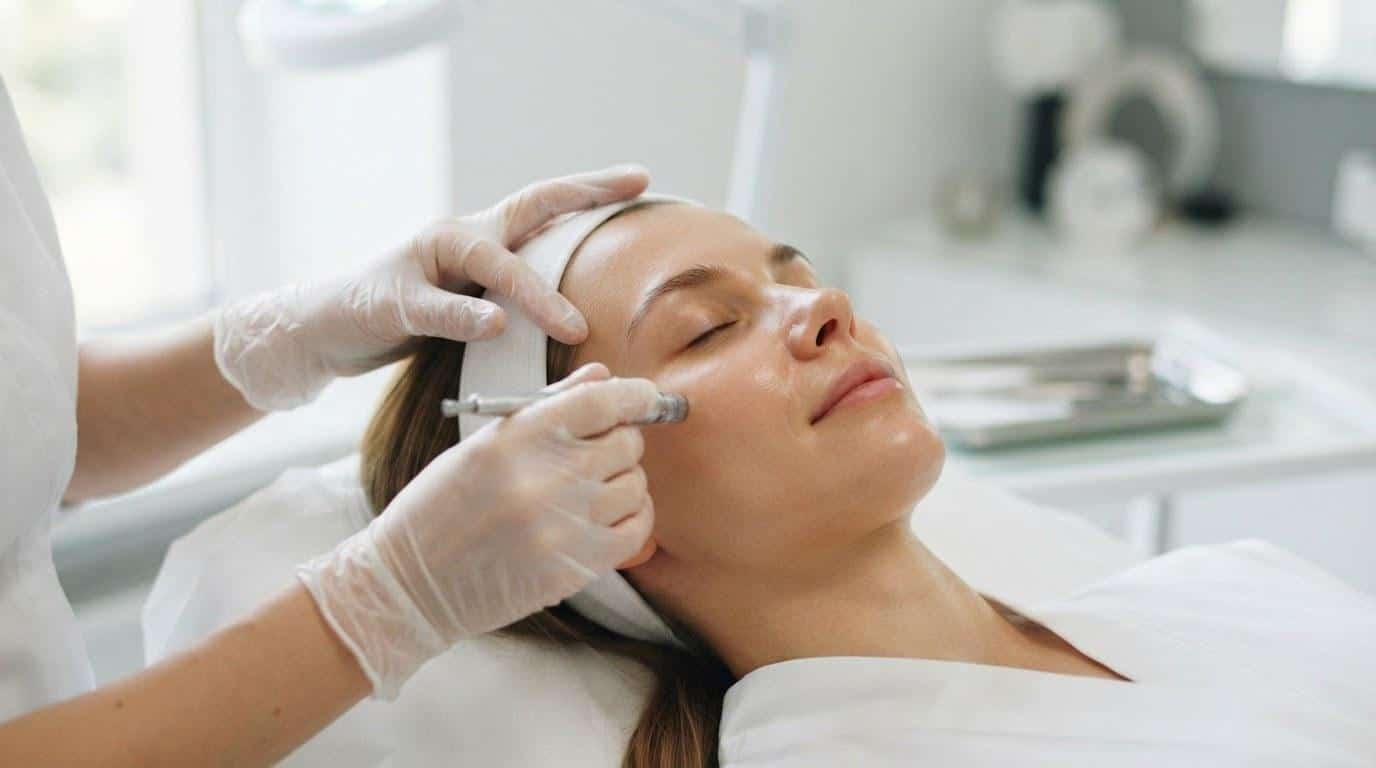
Tixel is one of the newer resurfacing technologies available at select med spas. It uses a heated titanium tip to create micro-channels in the skin through thermo-mechanical action rather than laser energy. This means it works safely on all skin tones without the risk of post-inflammatory hyperpigmentation that can come with some laser treatments. Most patients need 3 to 5 sessions spaced 4 weeks apart, with visible improvement in skin laxity, fine lines, and texture building over 3 to 6 months.
Microneedling creates thousands of tiny controlled injuries in the skin, triggering a collagen and elastin repair response. According to the American Academy of Dermatology, microneedling is effective for improving acne scars, enlarged pores, and overall skin texture. A standard series is 3 sessions spaced 4 to 6 weeks apart, with collagen remodeling continuing for up to 6 months after the final treatment.
The VI Peel is a medical-grade chemical peel that combines trichloroacetic acid, salicylic acid, phenol, retinoic acid, and vitamin C. It targets pigmentation, fine lines, and dullness with a peel cycle of about 5 to 7 days. It works on all skin types and is a strong option for patients dealing with sun damage, melasma, or uneven tone.
- Tixel: Best for laxity, fine lines, and patients who want low downtime with no laser risk.
- Microneedling: Best for texture, pores, and acne scarring across all skin tones.
- VI Peel: Best for pigmentation, sun damage, and surface dullness.
- Chemical peels (lighter): Good for maintenance and brightening between deeper treatments.
We track patient outcomes across resurfacing series and find that patients who complete a full 3-session microneedling course report roughly 60% more satisfaction with their skin texture than those who stop after a single session.
Patients who complete a full 3-session microneedling course report roughly 60% more satisfaction with their skin texture than those who stop after a single session.
How Much Do Med Spa Anti-Aging Treatments Cost in California?
In the Southern California market, neuromodulator treatments typically range from $12 to $20 per unit, dermal fillers from $700 to $1,200 per syringe, and resurfacing treatments from $300 to $800 per session, depending on the provider, the product used, and the scope of the treatment. Combination plans naturally affect the total investment.
Several factors move the cost up or down within these ranges:
- Product brand: Daxxify is generally priced higher per treatment than Botox because of its longer duration, but fewer annual appointments may offset that difference.
- Number of areas treated: A single zone like the forehead costs less than a full upper-face treatment that includes crow’s feet and frown lines.
- Filler type and volume: Specialty fillers for delicate areas like the tear trough or lips require more precision and are often priced per syringe rather than per mL.
- Provider credentials: Board-certified physicians, nurse practitioners, and licensed registered nurses with advanced injector training typically charge more than unlicensed or undertrained providers. That premium reflects training, safety protocols, and liability coverage.
- Treatment series vs. single sessions: Many med spas offer package pricing for resurfacing series that reduces the per-session cost by 10 to 20 percent.
The American Society of Plastic Surgeons publishes annual statistics showing that minimally invasive cosmetic procedures continue to grow in demand, which keeps pricing competitive across the California market. For an accurate quote based on your specific goals, request a personalized consultation rather than relying on general ranges.
As of 2026, med spa pricing in California is not regulated at a fixed rate, so the variation between providers can be significant. Always confirm what is included in a quoted price: the product brand, the number of units or syringes, and any follow-up appointments.
How Do You Choose the Right Treatment for Your Skin?
The right starting point is identifying your primary concern: dynamic wrinkles, volume loss, skin texture, or pigmentation. Most patients in their 30s and 40s benefit most from a neuromodulator plus one resurfacing treatment, while patients in their 50s and beyond often see the biggest change by adding a filler to address volume loss.
A good med spa provider will assess your skin in person before recommending anything. They should look at your facial anatomy, skin quality, and movement patterns, not just hand you a menu and ask what you want. The FDA recommends choosing a licensed medical professional with documented training in the specific procedure you are considering.
Here are the most common starting points by concern:
- Forehead lines and crow’s feet: Start with a neuromodulator. Botox, Dysport, or Daxxify will address these directly without any downtime.
- Flat or sunken cheeks: A hyaluronic acid cheek filler restores the mid-face lift that aging gradually removes.
- Thin or undefined lips: A soft HA lip filler adds definition and subtle volume in a single 30-minute appointment.
- Rough texture or large pores: A microneedling series or Tixel course will produce the most meaningful improvement over 3 to 6 months.
- Uneven tone or sun spots: A VI Peel or series of chemical peels targets pigmentation at the surface and mid-dermal level.
- Overall skin laxity: Tixel or a combination of microneedling and a biostimulatory filler addresses early laxity without surgery.
One pattern worth noting: patients who come in asking only about one concern often discover a second issue they had not prioritized once they see the full assessment. A flat mid-face, for example, can make under-eye hollowing look worse than it actually is. Treating the cheeks first sometimes eliminates the need for tear trough filler entirely.
Ready to Build Your Anti-Aging Plan?
The best anti aging treatments in 2026 are not one-size-fits-all. A plan built around your anatomy, your goals, and your lifestyle will always outperform a single treatment chosen from a menu.
Beauty Solutions Med Spa in Woodland Hills offers the full range of treatments covered in this guide, including Botox, Dysport, Daxxify, Jeuveau, Xeomin, dermal fillers, Tixel skin rejuvenation, microneedling, VI Peel, and chemical peels. The team works with patients across Southern California who want results that look natural and last.
Schedule a consultation to get a personalized treatment plan based on your skin, not a template. Call (818) 860-0100 to book your appointment with Beauty Solutions Med Spa today.
Frequently Asked Questions
How long does Botox actually last, and is Daxxify worth it for longer results?
Standard Botox typically lasts 3 to 4 months for most patients. Daxxify, which is newer, averages around 6 months per treatment and can last up to 9 months in some cases. If you find yourself rebooking Botox every 3 months and want fewer appointments per year, Daxxify is worth discussing with your injector at a consultation.
What is the best anti-aging treatment if I have never had anything done before?
For most first-time patients, a neuromodulator like Botox or Dysport is the best starting point. It requires no downtime, results are visible within 5 to 14 days, and it is fully reversible in the sense that it simply wears off if you do not love the outcome. A licensed provider at a med spa like Beauty Solutions Med Spa can assess your face in person and recommend the right starting dose and areas.
Can I combine Botox and fillers in the same appointment?
Yes, combining a neuromodulator with a dermal filler in the same session is common and generally safe when performed by a trained injector. Many patients treat the upper face with Botox and address volume loss in the cheeks or lips with filler at the same visit. Your provider will confirm the right sequence and timing based on your anatomy.
How many microneedling sessions do I need to see real results?
Most providers recommend a series of 3 sessions spaced 4 to 6 weeks apart for meaningful improvement in skin texture, pore size, and fine lines. Collagen remodeling continues for up to 6 months after the final session, so final results are not visible immediately. Maintenance sessions once or twice a year help sustain the improvement.
Is the VI Peel safe for darker skin tones?
The VI Peel is formulated to be safe for a range of skin tones, including medium and darker complexions, which makes it a popular option for patients who are not good candidates for certain laser treatments. It is still important to disclose your full skin history to your provider, as certain active skin conditions or medications can affect how your skin responds to a chemical peel.