


PRP vs. PRF: Which Platelet Treatment Is Right for You?
PRP vs. PRF: Which Platelet Treatment Is Right for You?
Should I Choose PRP or PRF? A Guide to Platelet-Rich Treatments
A common question when exploring advanced aesthetic treatments is: “What’s the real difference between PRP and PRF, and which one will actually work for my skin or hair concerns?” The answer depends entirely on how each treatment is processed, how your body absorbs the growth factors, and what specific results you’re targeting. Both platelet-rich therapies deliver concentrated healing compounds directly into problem areas, but the mechanism, timeline, and applications differ significantly—and understanding these distinctions will help you make an informed investment in your appearance.
📋 In This Guide
How PRP and PRF Are Processed Differently
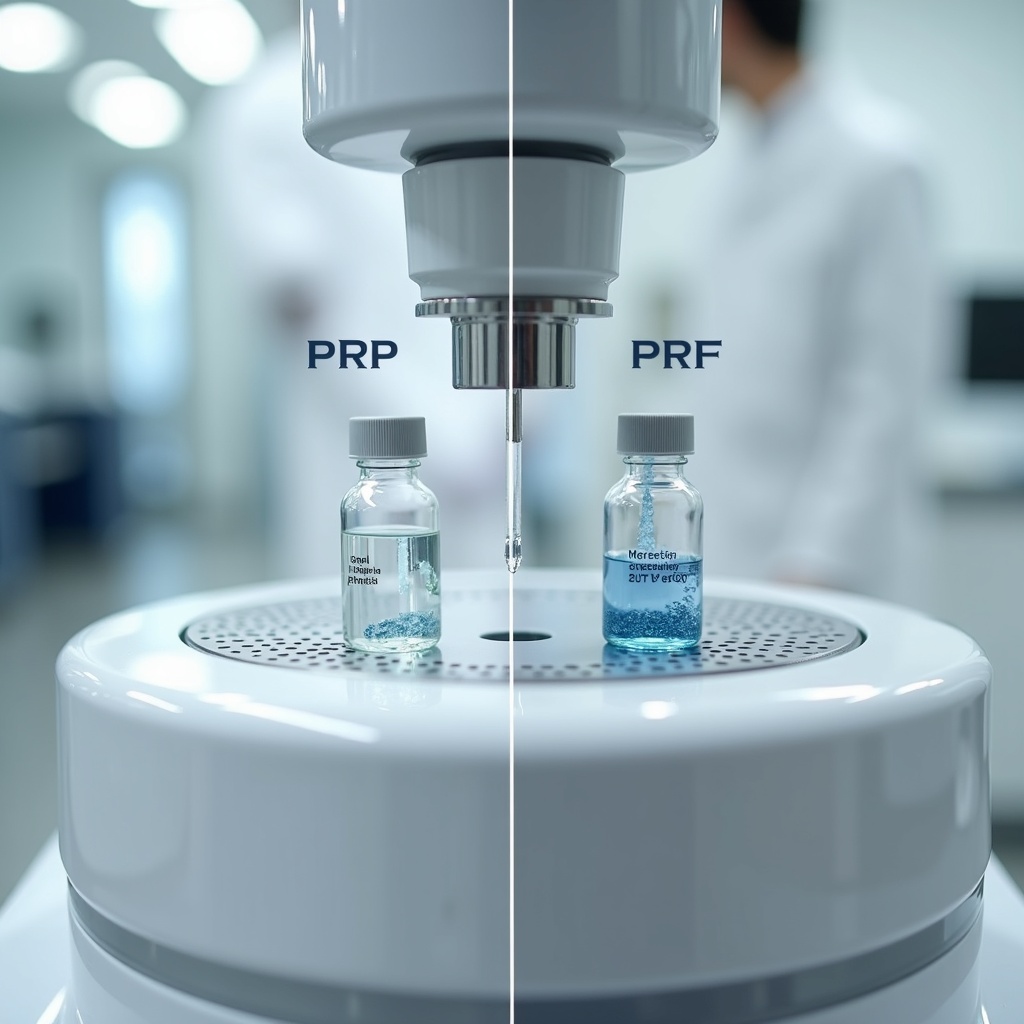
The fundamental difference between PRP (Platelet-Rich Plasma) and PRF (Platelet-Rich Fibrin) lies in centrifugation and the presence of anticoagulants. PRP requires an anticoagulant—typically sodium citrate or heparin—to prevent your blood from clotting during the separation process. Your blood spins in a centrifuge at lower speeds for a shorter time, resulting in a liquid plasma solution loaded with platelets. The anticoagulant keeps everything in suspension, making PRP injectable immediately.
PRF skips the anticoagulant entirely. Instead, your whole blood undergoes a specialized centrifugation protocol at specific speeds and durations. This process creates a fibrin clot—a natural scaffold that forms as the blood naturally coagulates during spinning. The result is a gel-like or putty-like consistency rather than a liquid. PRF can be used as-is or processed further into liquid injectable form, depending on the protocol and your treatment goals.
Growth Factor Release and Bioavailability
This processing difference creates a critical distinction in how your body absorbs the healing compounds. PRP releases growth factors immediately upon injection because the platelets are already activated in liquid suspension. You get a rapid burst of growth factors—platelet-derived growth factor (PDGF), vascular endothelial growth factor (VEGF), transforming growth factor beta (TGF-β)—right away. This makes PRP ideal for conditions requiring quick inflammatory response and cellular signaling.
PRF releases growth factors gradually over 7 to 28 days as the fibrin matrix naturally breaks down in your tissue. This sustained, slow-release mechanism mimics your body’s natural healing process more closely. You don’t get the immediate spike; instead, you get prolonged stimulation of fibroblasts, stem cell recruitment, and tissue regeneration. Many practitioners and patients prefer this slower timeline because it reduces inflammation and delivers more consistent long-term results.
Treatment Applications: Skin Rejuvenation vs. Hair Restoration
The choice between PRP and PRF often depends on whether you’re treating facial aging or hair loss—two of the most common applications in med spa practice.
Facial Rejuvenation and Scar Treatment
For facial rejuvenation, PRF has become increasingly popular because of its sustained growth factor delivery and the fibrin matrix’s ability to scaffold new collagen formation. When combined with chemical peels or microneedling, PRF’s gradual release supports steady collagen remodeling without the aggressive inflammatory spike that can lead to prolonged redness or swelling. Many patients report smoother skin texture, improved radiance, and better skin firmness over 6 to 8 weeks with PRF combined with microneedling.
PRP remains effective for facial rejuvenation, particularly when you want more immediate results or when combining it with laser resurfacing. The quick growth factor release triggers rapid fibroblast activation and can accelerate the repair phase after more aggressive procedures. Patients seeking faster visible improvement in fine lines and skin laxity often favor PRP in this context.
Hair Restoration Outcomes
For androgenetic alopecia and hair thinning, both treatments show promise, but study data and clinical observation suggest different strengths. PRP’s immediate growth factor delivery stimulates hair follicle stem cells quickly, making it useful for patients with active hair loss seeking to halt progression. Multiple sessions spaced 4 to 6 weeks apart are standard, as the acute stimulation diminishes over time.
PRF’s sustained release makes it theoretically superior for long-term follicle health and regeneration. The extended growth factor availability supports ongoing fibroblast activity in the dermal papilla—the nutrient-rich layer surrounding hair roots. Many practitioners report that PRF requires fewer maintenance sessions and produces denser, healthier hair growth over 3 to 6 months. However, both treatments demand patience; visible hair thickening typically appears 2 to 3 months after the first session.
Downtime, Recovery, and Results Timeline Comparison
| Factor | PRP (Platelet-Rich Plasma) | PRF (Platelet-Rich Fibrin) |
|---|---|---|
| Processing Time | 5–8 minutes | 10–15 minutes |
| Downtime (Facial) | 2–3 days redness/swelling | 1–2 days mild redness |
| Downtime (Hair) | Minimal; brief scalp sensitivity | Minimal; brief scalp sensitivity |
| Visible Results | 2–4 weeks (skin glow); 2–3 months (hair) | 4–8 weeks (skin texture); 3–6 months (hair) |
| Peak Results | 6–12 weeks | 3–6 months |
| Session Frequency | Every 4–6 weeks (3–4 sessions typical) | Every 4–8 weeks (2–3 sessions typical) |
| Maintenance | Quarterly boosters recommended | Annual touch-ups common |
The timeline difference matters significantly if you’re planning treatments around social or professional commitments. PRP tends to cause more noticeable redness and swelling immediately after facial application because of the rapid inflammatory response. PRF’s gentler release means less dramatic post-treatment inflammation, though full results take longer to develop.
For hair restoration, both treatments have similarly minimal downtime. You may feel slight scalp tenderness or warmth for a few hours, but you can return to normal activities immediately. The visible difference emerges in the timeframe: PRP patients often notice initial hair thickening within 8 to 12 weeks; PRF patients typically see sustained improvement over 4 to 6 months with potentially superior long-term density.
Combination Treatments and Synergistic Protocols
Many advanced practitioners now combine platelet-rich therapies with complementary procedures to amplify results. PRF microneedling—where PRF is applied during or immediately after microneedling—creates an ideal environment for collagen synthesis. The micro-injury stimulates fibroblasts, and PRF’s fibrin scaffold provides a sustained growth factor supply for weeks. This combination is particularly effective for treating acne scars, surgical scars, or overall skin texture irregularities.
PRP combined with laser resurfacing works differently. The laser creates controlled thermal injury and resurfaces damaged skin, while PRP’s immediate growth factor surge accelerates the healing response. This pairing reduces downtime and can produce more dramatic results for patients with sun damage, age spots, or moderate wrinkles. Some practices use PRP as a post-laser injection 24 to 48 hours after treatment to optimize the healing environment.
Hair restoration can also benefit from combination protocols. Some providers now offer PRP or PRF alongside low-level laser therapy (LLLT) or topical minoxidil for additive effects on follicle stimulation. Others layer PRP with scalp microneedling to enhance absorption and follicle penetration. These combinations demand more involved treatment plans but can yield superior density gains for patients committed to multi-modal approaches.
Candidate Selection: Who Benefits Most From Each Treatment
Your ideal candidate profile shifts based on your goals, skin type, and willingness to wait for results. PRP suits patients seeking quicker visible improvement, those with active inflammation requiring rapid control, or anyone combining it with aggressive laser procedures. If you have limited downtime tolerance or prefer seeing early results, PRP’s immediate growth factor release aligns better with your expectations.
PRF appeals to patients prioritizing natural, sustained healing and those with sensitive skin prone to prolonged redness. If you’re treating deeper structural concerns—significant volume loss, advanced scarring, or hair loss over a larger scalp area—PRF’s longer growth factor timeline and fibrin matrix structure support more thorough tissue remodeling. Patients focused on preventive wellness often favor PRF because the investment yields longer-lasting results with fewer maintenance sessions.
Skin type considerations matter. Patients with darker skin tones or a history of keloid formation require careful monitoring with both treatments, as the inflammatory response can trigger abnormal scarring. In these cases, working with an experienced provider who understands how to manage post-treatment inflammation across diverse skin types is essential. Some practitioners add intralesional steroid injections (such as triamcinolone) at risk sites following PRP or PRF treatment to prevent hypertrophic scarring in susceptible patients.
Value and Investment Perspective
Understanding the value proposition helps justify the investment in either treatment. Because PRF typically requires fewer sessions and delivers longer-lasting results, the total cost over 12 months may be lower despite individual session variability. If you commit to a 3-session protocol for PRF versus a 4-session PRP series, the cumulative investment often levels out—but PRF patients often skip the quarterly boosters that PRP patients need.
For hair restoration specifically, PRF’s extended timeline means you’re not paying for monthly maintenance sessions. One treatment every 8 to 10 months is common, whereas PRP typically demands quarterly touch-ups to maintain results. Over two years, this adds up meaningfully. Patients who prioritize efficiency and long-term value over upfront speed tend to find PRF’s delayed-but-sustained approach increasingly appealing.
Combination protocols demand a higher initial investment but often deliver superior outcomes that reduce the need for additional corrective procedures later. A single PRF microneedling session may cost more than either treatment alone, but if it addresses scarring that would otherwise require multiple laser sessions or injectable fillers, the long-term value becomes clear. Consulting with a qualified provider to map out a complete protocol—whether PRP, PRF, or a combination—is the most reliable way to align your treatment plan with your timeline, skin type, and budget.

Launa Stone has been a practicing registered nurse for over 30 years. After working in Critical Care, she began her career in plastic surgical nursing and skin care in 1989. She has worked with some of the country's most prominent plastic and reconstructive surgeons. In 1996, when Botox™ was introduced for cosmetic purposes, she began performing Collagen & Botox™ injections. Over 25 years later, Launa continues to be at the forefront of non-invasive medical and aesthetic technology. She is in the top 1% of injectors in the U.S. and among the first to preview Daxxify. Launa is a pioneer in Med-Spas, having started the first Med-Spa nationwide in Beverly Hills in the 1990's, then Brentwood in 2000, and founded Calabasas Med Spa in 2009. She has been featured as a "beauty expert" on "The Doctors" and in many magazines. Allergan has recognized her as a top provider of Botox, placing her in the top 250 of all Botox cosmetic injectors Nationwide.
❓ Frequently Asked Questions
How long does it take to see results from PRP versus PRF treatments?
PRP typically shows visible results within 2 to 4 weeks for skin glow and 2 to 3 months for hair thickening, because growth factors release immediately. PRF takes longer—4 to 8 weeks for skin texture improvement and 3 to 6 months for hair density—because growth factors release gradually over weeks as the fibrin matrix breaks down.
Which treatment requires less downtime after application?
PRF causes less immediate downtime for facial treatments, with typically 1 to 2 days of mild redness compared to PRP's 2 to 3 days of noticeable redness and swelling. Both have minimal downtime for hair restoration, though PRP's faster inflammatory response may cause slightly more scalp sensitivity initially.
Can I combine PRP or PRF with other aesthetic procedures like microneedling or laser resurfacing?
Yes—PRF is especially effective combined with microneedling because the fibrin scaffold supports sustained collagen remodeling, while PRP works well with laser resurfacing to accelerate healing. Many providers layer both approaches into comprehensive protocols to maximize results.
How often do I need maintenance sessions if I choose PRP or PRF at Launa Stone, R.N. in Agoura Hills?
PRP typically requires maintenance sessions every 3 to 4 months to sustain results, while PRF patients often need only annual touch-ups because the sustained growth factor release provides longer-lasting effects. Contact (818) 860-0100 to discuss your personalized maintenance plan.
